- Mach - Just another unit of Speed, but in terms of Sound. In mathematical context, it is the ratio of an aircraft's speed in relation to the speed of sound:
M = Velocity of Object / Speed of Sound.
Where M = Mach Number, Speed of Sound = 768 mph (if we presume the medium to be air).
Supersonic aircraft are aircaft which fly faster than Mach 1. Anything higher than Mach 5 is considered Hypersonic. Those beasts are usually unmanned (Imagine a pilot trying to control an aircraft going at like 2500 mph).
As Supersonic aircraft fly at faster speeds, the aerodynamics of them are completely seperate from transonic flights (normal commercial flights). Firstly their aerodynamic drag rises sharply, so to maintain speed one needs a design which can produce much greater engine power and a streamlined shape.
- Aerodynamic Drag - Let's break this word down - Aero means being in the "air". Drag means the force acting in the opposite direction relative to the motion of the object. So it basically is when an airplane is moving through the air, a force which acts in the opposite direction to it's movement, which results in a fall in velocity (speed).
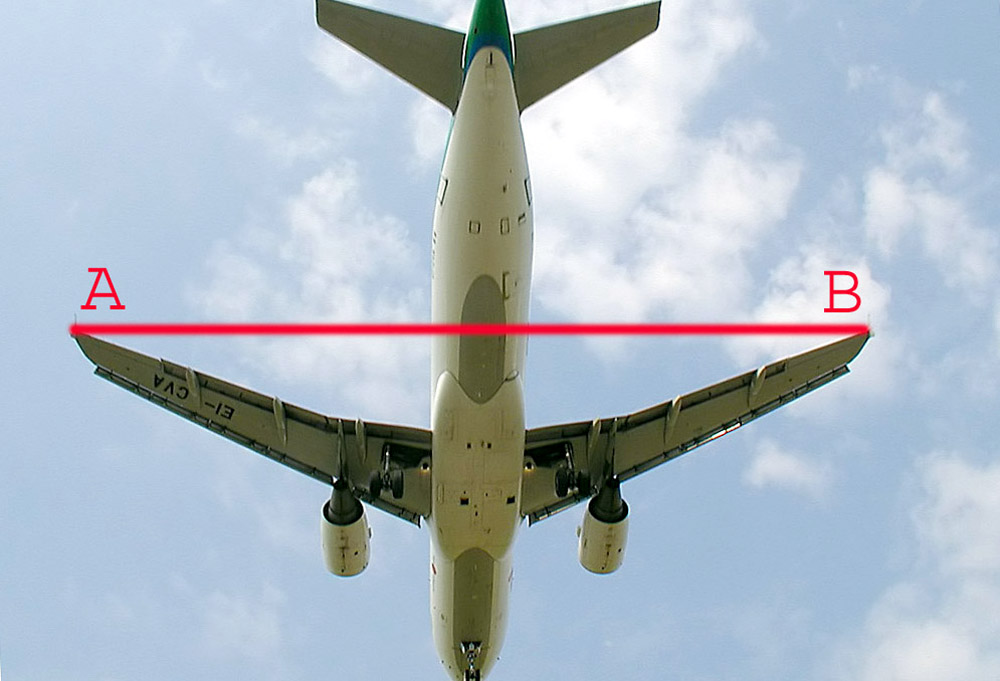
- Wingspan -The wingspan of an aircraft is the distance from one wingtip to the other wingtip. A picture on the right, describes what the wingspan of an aircraft is measured, it is always measured in a straight line !
http://www.princeton.edu/~stengel/MAE331Lectures.html
- Altitude - The height reached by an aircraft. So "high the aircraft is flying", usually passenger jets have a cruising altitude (the point of the flight, where the airplane is not climbing, or descending) of around anywhere between 25,000 to 38,000 ft. Supersonic aircrafts have a higher cruising altitude.
